
EVIDENCE BEHIND THE FORMULA
Lutein + Zeaxanthin (Lutemax® 2020)
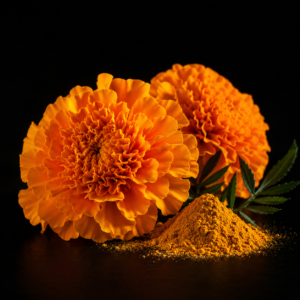
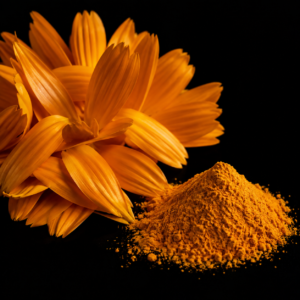
What it is: Yellow carotenoid pigments found in leafy greens and marigold flowers. In the eye they collect in the macula, the small central area of the retina used for sharp, detailed vision. Lutemax® 2020 from OmniActive is a marigold extract supplying lutein plus zeaxanthin isomers.
↑ Back to ingredient list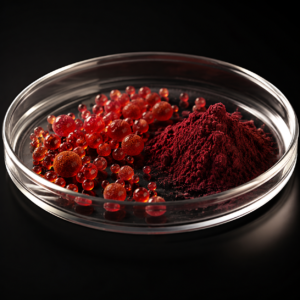
Astaxanthin (AstaReal®)
What it is: A red carotenoid pigment made by the microalga Haematococcus pluvialis, the same pigment that gives salmon its colour. AstaReal® is an algae-grown source.
↑ Back to ingredient list
ASTAXANTHIN + LUTEIN + ZEAXANTHIN
SCREEN-TIME VISUAL PERFORMANCE
LUTEMAX® 2020 — LUTEIN + ZEAXANTHIN ISOMERS
The B.L.U.E. study was a randomized, double-blind, placebo-controlled trial involving 48 healthy young adults who spent at least six hours per day using near-field digital screens. Participants received Lutemax® 2020 providing 24 mg of macular carotenoids daily, approximately 20 mg lutein plus 4 mg of zeaxanthin isomers, or placebo for six months.
RESULT
Compared with placebo, Lutemax® 2020 supplementation significantly increased macular pigment optical density and improved all visual-performance measures tested, including contrast sensitivity, critical flicker fusion, disability glare and photostress recovery. Participants also reported significant reductions in eye strain and eye fatigue, along with improvements in overall sleep quality and headache frequency.
SOURCE
Stringham JM, Stringham NT, O’Brien KJ. Macular Carotenoid Supplementation Improves Visual Performance, Sleep Quality, and Adverse Physical Symptoms in Those with High Screen Time Exposure. Foods. 2017;6(7):47. PMID 28661438. DOI 10.3390/foods6070047.
EYE–HAND COORDINATION AFTER SCREEN USE:
ASTAXANTHIN + LUTEIN + ZEAXANTHIN
A randomized, double-blind, placebo-controlled trial studied healthy adults who regularly used visual display terminals. Participants received 6 mg astaxanthin, 10 mg lutein and 2 mg zeaxanthin daily for eight weeks.
RESULT
The carotenoid combination significantly improved eye–hand coordination after screen use compared with placebo.
SOURCE
Yoshida K, et al. Effects of Astaxanthin, Lutein, and Zeaxanthin on Eye–Hand Coordination and Smooth-Pursuit Eye Movement after Visual Display Terminal Operation in Healthy Subjects: A Randomized, Double-Blind Placebo-Controlled Intergroup Trial. Nutrients. 2023;15(6):1459. PMID 36986186.
VISUAL ACUITY AFTER SCREEN USE:
ASTAXANTHIN
A randomized, double-blind, placebo-controlled trial studied 60 healthy adults receiving 9 mg of astaxanthin daily or placebo for six weeks. Visual function was measured before and after visual display terminal use.
RESULT
Across all participants, there was no significant difference between astaxanthin and placebo. In participants aged 40 and older, however, astaxanthin significantly reduced the decline in visual acuity following screen use compared with placebo.
SOURCE
Sekikawa T, Kizawa Y, Li Y, Miura N. Effects of diet containing astaxanthin on visual function in healthy individuals: a randomized, double-blind, placebo-controlled, parallel study. Journal of Clinical Biochemistry and Nutrition. 2023;72(1):74–81. PMID 36777084.
ATTENTION + INFORMATION PROCESSING:
Citicoline (CDP-Choline)
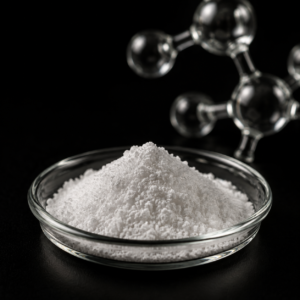
What it is: A compound the body makes from choline and cytidine. It supplies choline, which the brain uses to build cell membranes and the messenger acetylcholine.
↑ Back to ingredient listATTENTION + PSYCHOMOTOR SPEED
CITICOLINE (CDP-CHOLINE)
A randomized controlled trial studied 75 healthy adolescent males. Participants received 250 mg or 500 mg of citicoline, or placebo, daily for 28 days, with attention and psychomotor performance measured before and after supplementation.
RESULT
Participants receiving citicoline showed significantly improved attention and psychomotor speed compared with placebo. Higher weight-adjusted doses were also associated with greater attention accuracy and reduced impulsivity.
SOURCE
McGlade E, Agoston AM, DiMuzio J, et al. The Effect of Citicoline Supplementation on Motor Speed and Attention in Adolescent Males. Journal of Attention Disorders. 2019;23(2):121–134. PMID 26179181.
Phosphatidylserine
What it is: A phospholipid, one of the fats that make up every cell membrane, especially concentrated in brain cells. godmode uses a sunflower-derived source.
↑ Back to ingredient listWORKING MEMORY + REACTION TIME
PHOSPHATIDYLSERINE + WHOLE COFFEE CHERRY EXTRACT
A randomized, double-blind, placebo-controlled trial studied 138 healthy adults aged 40–65 with self-reported memory problems for 42 days. The tested formulation contained 100 mg phosphatidylserine and 100 mg whole coffee cherry extract daily.
RESULT
Compared with placebo, the formulation produced greater improvements in numeric working-memory accuracy and reaction-time measures, as well as picture-recognition accuracy.
SOURCE
Doma KM, Lewis ED, Barracato JM, et al. A Randomized, Double-Blind, Placebo-Controlled, Parallel Study Investigating the Efficacy of a Whole Coffee Cherry Extract and Phosphatidylserine Formulation on Cognitive Performance of Healthy Adults with Self-Perceived Memory Problems. Neurology and Therapy. 2023;12:777–794. PMID 36929344.
COGNITIVE PERFORMANCE UNDER MENTAL STRESS
PHOSPHATIDYLSERINE
A randomized, double-blind study followed 16 healthy adults for 42 days and examined cognitive performance and brain activity before and after induced mental stress.
RESULT
Phosphatidylserine supplementation altered frontal cortical activity associated with the stress condition, with the researchers interpreting the EEG findings as consistent with a more relaxed state compared with placebo.
SOURCE
Baumeister J, Barthel T, Geiss KR, Weiss M. Influence of phosphatidylserine on cognitive performance and cortical activity after induced stress. Nutritional Neuroscience. 2008;11(3):103–110. PMID 18616866.
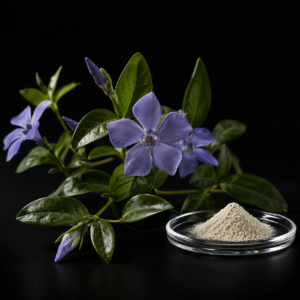
Vinpocetine
What it is: A compound made from vincamine, a natural alkaloid found in the lesser periwinkle plant (Vinca minor).
↑ Back to ingredient listMEMORY PROCESSING
VINPOCETINE
A randomized, double-blind crossover study tested vinpocetine in 12 healthy female volunteers. Participants received 10 mg, 20 mg, 40 mg or placebo three times daily for two days, followed by cognitive testing on the third day.
RESULT
The 40 mg vinpocetine condition significantly improved performance on the Sternberg memory-scanning test compared with placebo. The study found no significant improvement in choice reaction time or critical flicker-fusion testing.
SOURCE
Subhan Z, Hindmarch I. Psychopharmacological effects of vinpocetine in normal healthy volunteers. European Journal of Clinical Pharmacology. 1985;28:567–571. DOI 10.1007/BF00544068.
PERFORMANCE UNDER LOAD:
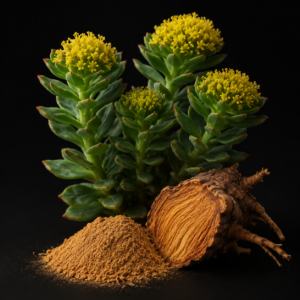
Rhodiola rosea
What it is: A flowering plant from cold, high-altitude regions of Europe, Asia and North America. Its root is traditionally used as an adaptogen, a plant used to help the body handle stress.
↑ Back to ingredient listREACTION TIME
RHODIOLA
A randomized, double-blind, placebo-controlled trial studied 26 healthy male students who received 600 mg of Rhodiola rosea extract daily or placebo for four weeks. Mental performance was assessed using simple- and choice-reaction tests.
RESULT
Rhodiola supplementation produced improvements in simple and choice reaction-time measures. The researchers concluded that chronic Rhodiola intake could improve performance on some psychomotor tests in young, healthy men.
(Simple reaction time means there is one known stimulus and one required response. Example: a light appears → press the button as quickly as possible. It mainly measures how quickly someone detects a signal and initiates a response. Choice reaction time is harder because there are multiple possible stimuli and multiple possible responses. Example: red light → press left; green light → press right. It therefore adds identification, decision-making and response selection to basic reaction speed.)
SOURCE
Jówko E, Sadowski J, Długołęcka B, et al. Effects of Rhodiola rosea supplementation on mental performance, physical capacity, and oxidative stress biomarkers in healthy men. Journal of Sport and Health Science. 2018;7(4):473–480. PMID 30450257.
MENTAL FATIGUE + NEUROMOTOR PERFORMANCE DURING EXAMS
RHODIOLA
A randomized, double-blind, placebo-controlled study followed 40 medical students during a stressful examination period. Participants received 50 mg of standardized Rhodiola rosea extract twice daily, or placebo, for 20 days.
RESULT
Compared with placebo, the Rhodiola group showed significant improvements in mental fatigue and neuromotor performance, as well as physical fitness and general well-being. Not every cognitive test improved significantly.
SOURCE
Spasov AA, Wikman GK, Mandrikov VB, Mironova IA, Neumoin VV. A double-blind, placebo-controlled pilot study of the stimulating and adaptogenic effect of Rhodiola rosea SHR-5 extract on the fatigue of students caused by stress during an examination period with a repeated low-dose regimen. Phytomedicine. 2000;7(2):85–89. PMID 10839209.
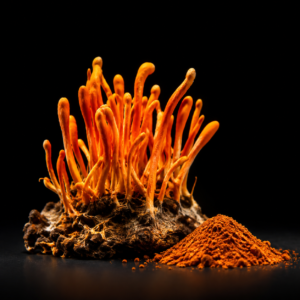
Cordyceps militaris
What it is: An orange, club-shaped mushroom used in traditional Asian practice. godmode uses a concentrated 8:1 extract from Nammex.
Note: the study below used Cordyceps sinensis (Cs-4), a related species.
↑ Back to ingredient listEXERCISE THRESHOLD + ENDURANCE
CORDYCEPS SINENSIS (Cs-4)
A double-blind, placebo-controlled trial studied 20 healthy adults aged 50–75. Participants received 333 mg of Cs-4 Cordyceps sinensis three times daily, or placebo, for 12 weeks.
RESULT
After 12 weeks, the Cordyceps group showed a 10.5% increase in metabolic threshold and an 8.5% increase in ventilatory threshold. VO₂ max did not significantly change.
SOURCE
Chen S, Li Z, Krochmal R, Abrazado M, Kim W, Cooper CB. Effect of Cs-4 (Cordyceps sinensis) on Exercise Performance in Healthy Older Subjects: A Double-Blind, Placebo-Controlled Trial. Journal of Alternative and Complementary Medicine. 2010;16(5):585–590. PMID 20804368.
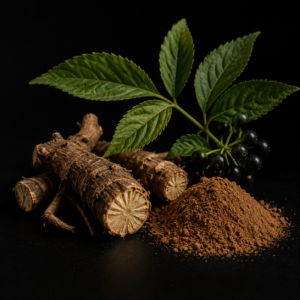
Eleuthero
What it is: A shrub native to northeast Asia, sometimes called Siberian ginseng. Its root is traditionally used as an adaptogen.
↑ Back to ingredient listENDURANCE CAPACITY
ELEUTHERO
A randomized, double-blind, placebo-controlled crossover study examined nine recreationally trained college-aged men. Participants received 800 mg of Eleutherococcus senticosus daily or placebo for eight weeks and then performed cycling exercise to exhaustion.
RESULT
After eight weeks, Eleuthero supplementation was associated with a 12% increase in VO₂ peak and a 23% increase in endurance time. The researchers also observed changes in exercise metabolism consistent with greater fat utilization and glucose conservation.
SOURCE
Kuo J, Chen KW, Cheng IS, Tsai PH, Lu YJ, Lee NY. The Effect of Eight Weeks of Supplementation with Eleutherococcus senticosus on Endurance Capacity and Metabolism in Human. Chinese Journal of Physiology. 2010;53(2):105–111. PMID 21793317. DOI 10.4077/CJP.2010.AMK018.
Glycine
What it is: The smallest amino acid. The body makes it, and it is found in protein foods such as meat, fish and beans.
↑ Back to ingredient listALERTNESS UNDER SLEEP RESTRICTION
GLYCINE — AMINO ACID SUPPORT
A randomized crossover study examined healthy adults during three consecutive nights in which sleep was restricted to 25% less than their usual sleep time. Participants received 3 g of glycine or placebo 30 minutes before bedtime.
RESULT
Glycine significantly improved reaction time on a psychomotor vigilance test during sleep restriction. Participants also reported significantly less fatigue on the first day of restricted sleep, while several other performance measures did not significantly differ from placebo.
SOURCE
Bannai M, Kawai N, Ono K, Nakahara K, Murakami N. The Effects of Glycine on Subjective Daytime Performance in Partially Sleep-Restricted Healthy Volunteers. Frontiers in Neurology. 2012;3:61. PMID 22529837. DOI 10.3389/fneur.2012.00061.
ADDITIONAL RESEARCH
VISUAL SYSTEM
Stringham NT, Holmes PV, Stringham JM. Effects of macular xanthophyll supplementation on brain-derived neurotrophic factor, pro-inflammatory cytokines, and cognitive performance. Physiology & Behavior. 2019;211:112650. PMID 31425700.
https://pubmed.ncbi.nlm.nih.gov/31425700/
Stringham JM, O’Brien KJ, Stringham NT. Contrast Sensitivity and Lateral Inhibition Are Enhanced With Macular Carotenoid Supplementation. Investigative Ophthalmology & Visual Science. 2017;58(4):2291–2295. PMID 28431432.
https://pubmed.ncbi.nlm.nih.gov/28431432/
Stringham JM, O’Brien KJ, Stringham NT. Macular carotenoid supplementation improves disability glare performance and dynamics of photostress recovery. Eye and Vision. 2016;3:30. PMID 27857944.
https://pubmed.ncbi.nlm.nih.gov/27857944/
Bovier ER, Renzi LM, Hammond BR. A double-blind, placebo-controlled study on the effects of lutein and zeaxanthin on neural processing speed and efficiency. PLOS ONE. 2014;9(9):e108178. PMID 25251377.
https://pubmed.ncbi.nlm.nih.gov/25251377/
Yao Y, Qiu QH, Wu XW, Cai ZY, Xu S, Liang XQ. Lutein supplementation improves visual performance in Chinese drivers: 1-year randomized, double-blind, placebo-controlled study. Nutrition. 2013;29(7–8):958–964. PMID 23360692.
https://pubmed.ncbi.nlm.nih.gov/23360692/
Katagiri M, Satoh A, Tsuji S, Shirasawa T. Effects of astaxanthin-rich Haematococcus pluvialis extract on cognitive function: a randomised, double-blind, placebo-controlled study. Journal of Clinical Biochemistry and Nutrition. 2012;51(2):102–107. PMID 22962526.
https://pubmed.ncbi.nlm.nih.gov/22962526/
ATTENTION + INFORMATION PROCESSING
Nakazaki E, Mah E, Sanoshy K, Citrolo D, Watanabe F. Citicoline and Memory Function in Healthy Older Adults: A Randomized, Double-Blind, Placebo-Controlled Clinical Trial. Journal of Nutrition. 2021;151(8):2153–2160. PMID 33978188.
https://pubmed.ncbi.nlm.nih.gov/33978188/
Kato-Kataoka A, Sakai M, Ebina R, Nonaka C, Asano T, Miyamori T. Soybean-derived phosphatidylserine improves memory function of the elderly Japanese subjects with memory complaints. Journal of Clinical Biochemistry and Nutrition. 2010;47(3):246–255. PMID 21103034.
https://pubmed.ncbi.nlm.nih.gov/21103034/
PERFORMANCE UNDER LOAD
Shevtsov VA, Zholus BI, Shervarly VI, et al. A randomized trial of two different doses of a SHR-5 Rhodiola rosea extract versus placebo and control of capacity for mental work. Phytomedicine. 2003;10(2–3):95–105. PMID 12725561.
https://pubmed.ncbi.nlm.nih.gov/12725561/
Darbinyan V, Kteyan A, Panossian A, Gabrielian E, Wikman G, Wagner H. Rhodiola rosea in stress induced fatigue — a double blind cross-over study of a standardized extract SHR-5 with a repeated low-dose regimen on the mental performance of healthy physicians during night duty. Phytomedicine. 2000;7(5):365–371. PMID 11081987.
https://pubmed.ncbi.nlm.nih.gov/11081987/
RELATED + MECHANISTIC RESEARCH
Naber M, Hommel B, Colzato LS. Improved human visuomotor performance and pupil constriction after choline supplementation in a placebo-controlled double-blind study. Scientific Reports. 2015;5:13188. PMID 26271904.
https://pubmed.ncbi.nlm.nih.gov/26271904/
Note: This study used choline bitartrate, not citicoline, so it should be identified as related choline research rather than direct evidence for godmode’s citicoline.
Gulyás B, Halldin C, Sandell J, et al. PET studies on the brain uptake and regional distribution of [11C]vinpocetine in human subjects. Acta Neurologica Scandinavica. 2002. PMID 12460136.
https://pubmed.ncbi.nlm.nih.gov/12460136/
Note: This is mechanistic evidence showing human brain uptake and regional distribution of vinpocetine, not a cognitive-performance trial.